For a band once described as “too dark for pop” and “too electronic to last,” Depeche Mode have developed an almost mischievous relationship with time. Every few years, the narrative quietly forms: this is the end, the graceful fade-out, the victory lap. And every few years, Depeche Mode respond by doing the exact opposite.
In 2026, they are not merely surviving. They are omnipresent.
They are soundtracking viral TikTok edits made by teenagers who weren’t alive when Violator dropped. They are selling out stadiums in cities where the band once played theaters. They are still pushing Memento Mori—not as a relic of grief or a final statement, but as a living, expanding era that refuses to settle into nostalgia.
This is not a comeback story. This is something stranger, quieter, and far more impressive: endurance as reinvention.
From Mourning to Momentum
When Memento Mori arrived, it carried a weight that no marketing campaign could manufacture. The album was shaped by loss, reflection, and an awareness of mortality that felt raw rather than theatrical. For many listeners, it sounded like a band confronting the void with clear eyes.
What no one predicted was how long the record would echo.
Instead of receding after its initial tour cycle, Memento Mori became a slow-burn phenomenon. Songs that initially felt austere and inward—tracks defined by restraint, tension, and negative space—began to mutate in the public consciousness. Live performances stretched them into something more volatile. Remixes reframed them for club systems and headphones alike. Lyrics about impermanence found new meaning in a world obsessed with documentation and disappearance.
Rather than closing a chapter, Memento Mori opened one.
The TikTok Effect (Without the Pandering)
Depeche Mode did not “go viral” in the traditional, desperate sense. There were no forced dance challenges, no ironic brand partnerships, no awkward attempts to speak Gen-Z slang. Instead, their music simply… fit.
On TikTok, the platform’s endless appetite for mood found a natural ally in Depeche Mode’s catalog. Enjoy the Silence became shorthand for doomed romance edits. Policy of Truth underscored confessional storytimes. Deep cuts—once known only to longtime fans—reappeared as sonic backdrops to fashion montages, nighttime cityscapes, and existential jokes delivered with a straight face.
Memento Mori tracks slid into this ecosystem seamlessly. Their minimalism made them flexible. Their darkness felt authentic rather than performative. In a digital culture saturated with irony, Depeche Mode offered sincerity without optimism—a rare and strangely comforting combination.
The band didn’t chase the algorithm. The algorithm came to them.
Stadiums, Not Museums
There’s a crucial difference between legacy acts who sell tickets and those who sell moments. In 2026, Depeche Mode belong firmly to the latter category.
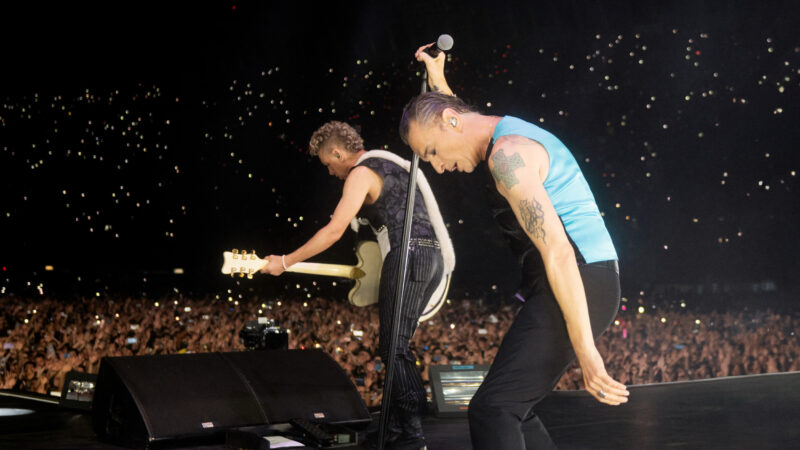
Their stadium shows are not retro showcases or greatest-hits jukeboxes. They are immersive, austere, almost confrontational experiences. The visuals remain stark. The sound is massive but controlled. Dave Gahan commands the stage with the confidence of someone who knows he doesn’t need to prove anything—and the hunger of someone who still wants to.
The crowd tells the real story. It is generational, unruly, and emotionally invested. Longtime fans stand beside first-timers who discovered the band through a 12-second clip on their phone. The response to Memento Mori material rivals that of songs released decades earlier—not out of politeness, but because the songs have embedded themselves into people’s lives.
These aren’t farewell tours. They feel like declarations.
Aging Without Softening
What makes Depeche Mode’s current phase so compelling is their refusal to sand down their edges. Many artists soften with age, chasing comfort or warmth. Depeche Mode have done the opposite. Their sound remains cold, precise, and emotionally unsparing.
That honesty resonates in 2026.
In an era where pop culture often feels engineered for constant positivity or distraction, Depeche Mode continue to explore doubt, guilt, desire, and death without apology. They don’t offer solutions. They offer space. And for many listeners—especially younger ones navigating an unstable world—that space feels radical.
Memento Mori doesn’t fade because its themes haven’t faded. If anything, they’ve sharpened.
Legacy as a Living Thing
There is a temptation to frame Depeche Mode as survivors of a bygone era, still standing out of stubbornness. That framing misses the point.
Their legacy is not static. It is actively rewritten every time a new listener stumbles onto their music without context, without reverence, and simply feels something. Every sold-out stadium in 2026 is not a victory over time—it’s proof that relevance doesn’t have an expiration date if the work remains honest.
Depeche Mode don’t chase youth. They don’t chase trends. They don’t chase closure.
They move forward, slowly and deliberately, dragging their shadows with them.
Not Done. Not Even Close.
If Memento Mori taught us anything, it’s that Depeche Mode understand impermanence better than most. They know everything ends. They just refuse to rush it.
In 2026, the band stands as a reminder that darkness doesn’t age out, that introspection can still fill stadiums, and that music built on conviction rather than convenience has a way of resurfacing exactly when it’s needed.
Depeche Mode are not done yet.
And if history has taught us anything, it would be unwise to bet against them.